Saturday, March 03, 2012

California Glass Expert Examines the Edge of Tempered Glass


California glass expert uses a grazing angle surface profilometer (GASP) to study the compressive stresses at the edge of a tempered glass oven door. The edge effects during the air quench step of the thermal temper process are said to lower the surface stress to zero near the edge of the glass article. In fact, fragmentation tests of tempered glass pieces yield a "picture frame" around the edge of the part. Fir this reason, a GASP was used to examine surface stress at the edge. Upper left is an image of the GASP interference pattern in the center of a tempered glass toaster oven door. The surface compressive stress measures 17,000 psi. Upper right is a similar image measured near the edge of the part. In this region the fringes curve, and they show the surface stress going to zero. This is important because any damage to the glass in this region of reduced surface compression stress is more likely to cause failure. 

Labels: ,

Sunday, February 19, 2012

Rubber Failure Analysis: Inner Tube Failure

 California failure analysis lab performs rubber failure analysis on a failed bicycle inner tube. The rider was braking while descending a long steep hill. Toward the bottom of the hill his inner tube failed, and he heard a loud pop. The wheel rim was too hot to touch. A failure analysis was performed and the failure originated at a point on the tube that would have been in contact with a spoke "nut". It is believed that the tube was heated to the highest temperature at this location, and it softened to the point of failure. In addition, the tire pressure was elevated due to the heating of the rim from the friction of the brake pads. Upper right is a 40X photo-micro graph of the failure origin.

Labels: ,

Sunday, February 12, 2012

California Failure Analysis Lab Examines Stainless Steel Corrosion Failure


Stainless steel corrosion failures often result from grain boundary sensitization. Many 300 series stainless steel alloys come in two grades or more. For example 304 stainless steel comes as 304, 304L and 304H. Each grade has a different amount of carbon (C). the 304 grade allows up to .0.08% C; whereas
304 L allows a maximum of 0.03% C. In corrosive environments, this is critical if the piece is welded or heated in the temperature range from 459°C to 850°C. As the carbon content increases in the alloy, the time for grain boundary sensitization decreases. Grain boundary sensitized stainless steels exhibit rapid corrosion  failure at the grain boundary because the chrome has been tied up by the carbon in the grain boundaries.
In this case the California failure analysis expert performed a corrosion failure analysis on a jacketed pipe made from 304 stainless steel which corroded rapidly as a result of grain boundary sensitization. The alloy was not specified correctly. The design drawings should have specified solution treated 304L or 316L plate for the manufacture of the industrial pipe. The plumbing failure expert  contends that if this were done, the plumbing failure would not have occurred. The equipment designer cannot rely on the supplier to pick the proper materials..  

Labels: , , ,

Thursday, February 02, 2012

Glass Expert Witness Services


Read Consulting is a California failure analysis laboratory that provides a complete line of glass expert witness services. These include glass failure analysis, window damage assessment,  patent expert witness support and stress testing. In addition Read Consulting also offers glass expert witness support in all areas of glass and ceramic machining and processing.  Process and device patent expertise is also provided.  


Labels: , ,

Saturday, January 28, 2012

California Failure Anal


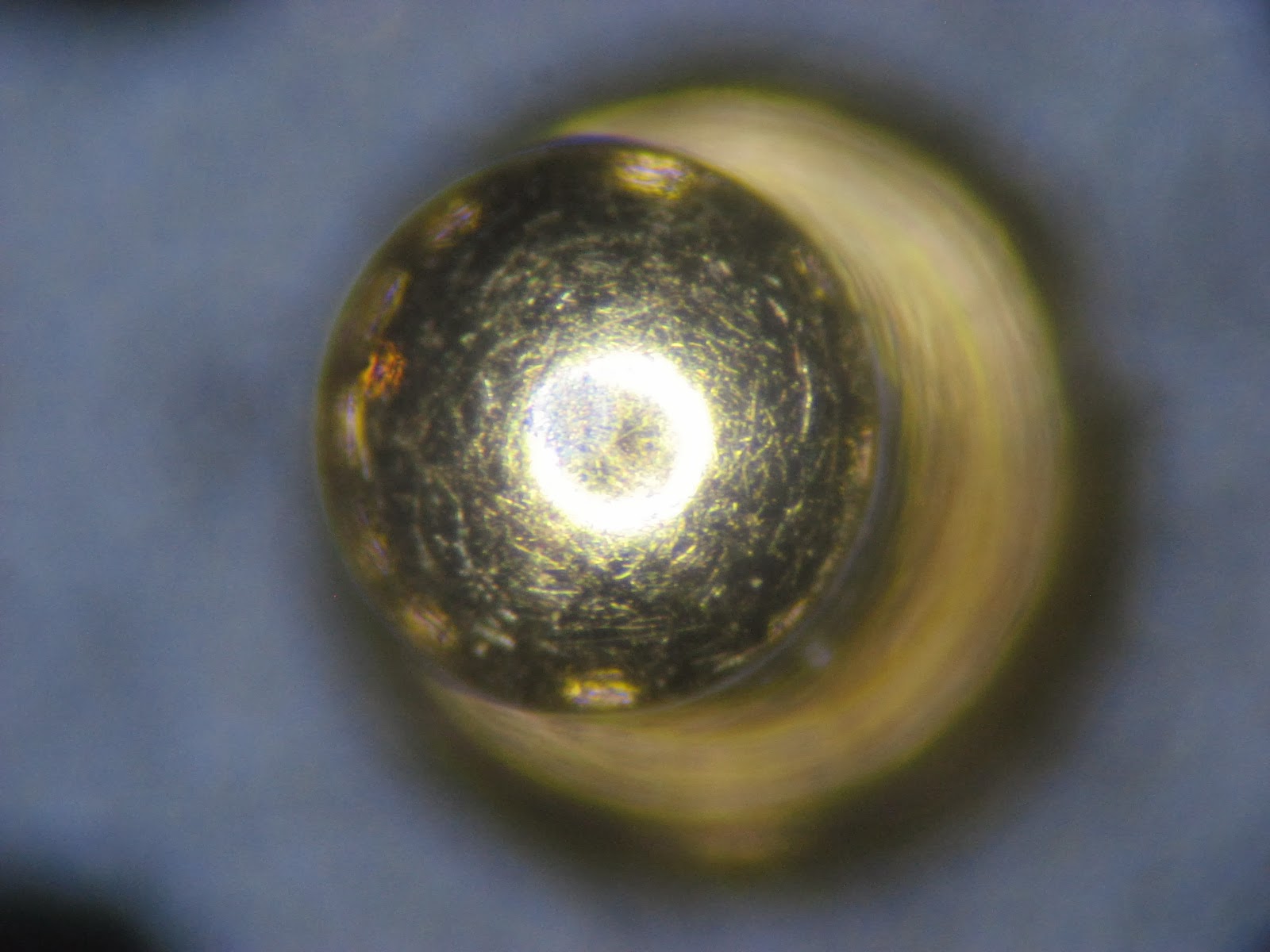
California Failure Analysis lab performed an electronic failure analysis on Pogo pin spring loaded contacts (Pogo connector pins) to determine the cause of intermittent open circuits. Electronic testing had detected that there were times when the spring loaded pin was depressed, the circuit would open and there would be an interruption of the signal. The cross section of a single Pogo (upper left) showed that the  the structure was entirely made of gold plated parts (pin, spring and outer
 case).  However, there was some concern that the inner wall of the case
was defective. For additional failure analysis, a sample case was split open (photo-micrograph on the right) and the inner surface was found to have horizontal machining marks,  not be plated, to be corroded and contaminated with plating salts. These plating defects indicate that the intermittent contact problem will worsen with time. These results are not surprising since the case is really a deep blind hole, and this makes it impossible to properly clean and plate  the interior. The vendor being analyzed is an overseas vendor that was to replace a reliable US supplier. These parts are unusable.


Labels: , , ,

Sunday, January 22, 2012

Rubber Failure Analysis: Rubber Seal Failure Analysis


A California failure expert witness was asked to determine the root cause of a rubber gasket leak. 
The molded rubber gasket seal was integrated into a hydraulic lift operating at 650 psi. Over time it had developed a very small hole and approximately 60 gallons of hydraulic oil escaped through this small leak. Read Consulting Failure Analysis Lab was asked to perform a detailed failure analysis to determine the cause of the leak.  The subject rubber seal failed as a result of a rubber molding defect. During the molding operation there was a region where the flowing rubber failed to re-bond properly. Over time the high pressure (650 psi) hydraulic oil created a hole in the weakened rubber and this resulted into a rubber failure and a hydraulic leak. Upper left is a 30X  photo-micrograph of the pinhole leak. The leak "protrudes" outward showing that the failure was created as a result of the hydraulic pressure. 

Labels: , , , ,

Tuesday, January 17, 2012

Device Patent Dispute: Automobile Rear View Mirrors


Read Consulting, a California failure analysis laboratory, often becomes involved with device patent disputes. In this case a patent dispute focused on external automobile rear view mirrors that had integral flashers showing through openings in the mirror. The assembly consisted of an array of LED lights that were behind the mirror, and these flashed through holes etched in the thin film chromium front surface mirror. Read Consulting had the electronic device expertise and thin film expertise to understand the various elements of the patent and to render an opinion in the patent dispute. Curiously, the same equipment that is used to perform failure analysis is also useful for examining elements in a patent dispute.

Labels: , , ,

Thursday, January 12, 2012

Construction Defect Analysis, Window Damage


California Failure Analysis Expert Witness performs a glass failure analysis on defective tempered glass windows installed in a public building. One of the construction defects was window scratching. Representative windows were removed and sent to the Read Consulting California failure analysis lab. This allowed a detailed investigation of the window defects. The failure analysis determined that the scratches were caused by post construction cleaning. Upper left is a macrophotograph of a typical set of scratches. Their parallel nature shows them to have been caused by a metal scraper. Upper right is a 40X photomicrograph of a scratched region. These scratches were in the glass. There was no coating on the scratched surface.  

Labels: , , ,

Sunday, January 01, 2012

Glass Failure Analysis of Tempered Glass Oven Door


California failure analysis expert witness analyzes a failed tempered glass toaster oven door to determine the cause of failure. The glass door remained intact, and this allowed the failure analysis to be performed. The origin is found to be in the center of a "butterfly" shaped region. There is a crush point that is the origin. The glass failure started at the crush region on the glass door surface and progressed inward till the residual stresses of the thermally tempered glass took over and caused the entire door to break into very small cubes. Upper left is an overview of the failed oven door. Upper right is a photomicrograph of the fracture surface at the origin.

Labels: , ,

Tuesday, December 27, 2011

Discussion of Beer Bottle Defect


California failure analysis expert witness discusses bottle defects that can affect the bottle strength. In this case there are a string of bubbles in the glass that are mear the surface. There are cases where these bubbles have reached the surface and have opened. This will weaken the bottle by generating  stress risers and thinning the glass locally. Due to hoop stresses, the strength of the bottle is directly proportional to the glass thickness, there are cases where this type of defect can significantly reduce the glass thickness and the bottle strength. This is particularly important in the case of beer and sodas, where the bottle contents are under pressure (54 to 50 psi). In this case the bubbles have not surfaced, thus the effect on the bottle strength is not as severe.

Labels: , ,

Monday, December 19, 2011

California Glass Expert Discusses Bottle Failure Analysis

A California failure analysis expert has been testing the strength of beer bottles by causing them to fail from pressure overload. In all cases the origin always had a mirror region at the origin. The presence of the mirror region indicates that the crack initially grows slowly. Theoretically, the mist hackle  indicates that the crack velocity has reached its terminal velocity. As a part of bottle failure analysis, the absence of this mirror region would indicate that the bottle did not fail as a result of internal pressure. In addition, the presence of crushed glass and mechanical damage at the origin would indicate that the bottle had been hit by a hard object.

Labels: , ,

Saturday, November 26, 2011

Tempered Glass Failure: Nickel Sulfide Particle

California failure analysis expert examines glass door failure to determine the root cause of the failure. The subject tempered glass door failed spontaneously, and because the glass was verticle, the broken pane remained intact. Read Consulting failure analysis laboratory was able to obtain the origin and perform a root cause failure analysis. The attached 25X Nomarski photomicrograph demonstrates that the glass failure originates at a nickel sulfide (NiS) particle. Once the glass failure has been initiated, the failure is driven by the residual stresses in the thermally tempered glass.  Glass fracture analysis shows the Wallner lines initiating at and expanding from a NiS particle. NiS particles are common in float glass, but they are only a problem in thermally tempered glass. Read Consulting Laboratory performs similar failure analyses on metals, plastics, ceramics and glass on a regular basis 

Labels: , , , ,

Thursday, November 03, 2011

Chicago High Rise Window Failures


A Northern California failure analysis expert witness performs a glass failure analysis on broken tempered glass windows removed from a recently built Chicago Illinois high rise. Soon after construction windows in the high rise began to fail. Read Consulting which provides failure analysis services in Santa Rosa California was contracted to determine the cause of failure. A portion of each window containing the failure origin was preserved and sent to the Read Consulting failure analysis laboratory. The failed windows were deconstructed and the fracture surface at the origin was examined microscopically. Root cause failure analysis demonstrated that the high rise windows failed as a result of nickel sulfide, NiS, inclusions in the glass. One photo above show a representative window failure. The other photo is a 500X photomicrograph (taken with Nomarski optics) of one of the NiS particles. It is a 170µ diameter spherical particle. The arrows indicate the direction of the spreading crack. 

Labels: , , ,

Thursday, October 27, 2011

Northern California Failure Expert Witness Describes Tubing Failure


An interesting failure of steel tubing was observed when 1 3/4" diameter A513 Type 5 steel tubing was being bent in a tubing bender. In this case the tube was clamped into the bender in the wrong location. At this time the clamp bolt had made an indentation (nick) in the pipe surface. The pipe was released and moved. The "nick" ended up on the tensile surface (i.e. convex side of the bend) during bending. As the tubing was being formed it broke in a ductile manner. A513 Type 5 steel is work hardened and therefore has little ductility, and it cannot survive bending if the surface has been damaged. The appropriate tubing should have been made of C 1020 mild steel. Upper left is a photograph of the nick on the convex side of the bend. The failure is interesting because it is a progressive failure that was caused by non-cyclic stresses (i.e. it is not metal fatigue). In addition, there are faint crack arrest lines that show the progression of the ductile failure. The failure surface almost looks like metal fatigue. This fsailure did not occur when C 1020 tubing was treated in the same manner. This failure was the result of improper material selection. It is not the result of a manufacturing defect.

Labels: , , ,

Thursday, October 20, 2011

Brass Plumbing Failure Analysis Stress Corrosion Cracking (SCC)


California failure analysis expert witness has analyzed numerous plumbing failures involving yellow brass (i.e. brass with more than 30% Zn in the alloy). The two major brass failure modes in yellow brass are dezincification and stress corrosion cracking. Above are two samples of stress corrosion cracking. Sress corrosion of yellow brass commonly involves the presence of ammonia along with the presence of stress. Upper left is a photo of a brass ferrule that cracked. The stress came from the clamping force of the ferrule on the rubber hose. These ferrules were covered with an expanded foam insulation that was painted with latex paint. At a minimum the latex paint contained ammonia; it is also believed that there was residual ammonia in the rubber foam insulation. Upper right is a failed flexible bathroom water supply line. The stress in this pipe failure is residual stress from non-uniform bending. It is believed that the ammonia came from houshold cleaners used on the plumbing. In both cases, the cracking is inter granular cracking and is attributed to stress corrosion cracking.

Labels: , , , ,

Friday, October 14, 2011

California Failure Analysis Expert Witness Examines Window Damage


Window cleaning is an important final step in finishing off construction of a building. This fact is sometimes ignored, and improper cleaning results in significant damage to the new windows. This in turn leads to a lawsuit. The glass association of North America (GANA) has published a bulleton to instruct as to the proper window cleaning procedures, and it strictly prohibits the use of  metal blades. Above are photographs of two examples of the type of window damage caused when blades are used to clean windows on new construction. This damage was discovered during a window damage failure analysis.  These windows are two of over 1000 showing window scratching from window cleaning damage. The parallel nature of the scratches indicates that dirt was caught under a metal blade and dragged across the window and scratched the surface.

Labels: , ,

Tuesday, October 04, 2011

Failure Analysis of Glass Pot: Visions Cookware


A failure analysis  was performed on a broken 5 quart stove top glass pot. The origin was determined with optical microscopy, and the broken pot was assembled to show how cracking proceeded. The re-assembled pot is shown upside down in the upper left photograph. The failure originated at a preexisting "chip" on the interior at the top rim of the pot. In this case, the the Wallner lines indicated that, initially, the crack grew as a result of bending forces. Although the user had claimed that there was no impact involved in the failure event. The physical evidence indicates that this pot had been "bumped" on the outside near the top rim. It is important to realize that table top glass cook ware is just as fragile as normal annealed glass. It just has a much lower thermal coefficient of expansion. A large pot such as the one in this investigation is heavy, and a minor "bump" to the pot can generate high enough forces to cause failure and potential injury to one holding the pot. It is not unusual to have chips on the inner rim of such a pot due to the fact stainless steel spoons can be used to stir the contents. This failure analysis eliminated the possibility of a product defect or a manufacturing defect.

Labels: , , , ,

Monday, September 26, 2011

Rubber Failure Analysis Demonstrates Rubber Fatigue

California rubber failure analysis expert performs a failure analysis on a rubber paddle. This piece failed as a result of fatigue. The fatigue failure initiated on the outer surface at a stress riser and progressed inwards. This is damonstrated by the photomicrographs above. Upper left is taken at 10X. Upper right is taken at 40X. The fracture surface has all the aspects of a classic fatigue failure.


Labels: , , ,

Monday, September 19, 2011

Medical Device Failure Analysis of a Catheter

California failure analysis expert witness performed a failure analysis on a piece of rubber that had been removed from a patient's bladder. The piece was compared with the tip of a new exemplar catheter. Although the piece that was removed surgically was encrusted with salts, it was shown to be part of a catheter.

Labels: ,

Saturday, September 10, 2011

Swing Set Failure Analysis

California failure analysis expert analyzes forces necessary to cause a swing set to fail. There are times that it is claimed that a swing set failed under "normal use" conditions. Tests were performed to determine what minimum forces are necessary to cause the chain to be pulled from the 'S' hook that holds it to the top of the swing set. Exemplar assemblies were put together and tested. The photographs above show the testing of an assembly. These tests showed that at least 400 pounds minimum is needed to pull the chain out. The above chain/'S' hook orientation required the minimum force. Other orientations required higher forces. This indicates that a child swinging on the saet could not generate the necessary forces to cause the chain to pull out of the 'S' hook.

Labels: , ,