Monday, June 06, 2011

Plumbing Failure Analysis


Northern California failure analysis expert often performs plumbing failure analysis. In this case, the corrosion expert examines plumbing in numerous houses that was plugged due to brass dezincification of yellwo brass. In this case the zinc in the copper zinc alloy corrodes selectively and this leaves a white deposit on the interior of the pipe. The white material is a combination of zinc oxide and zinc carbonate. Above is an example of significant dezincification; however this pipe is still fairly open. One can see that the flow of the water is from the brass to the copper and the corrosion product is being dragged into the copper pipe from the corroding brass fitting that is soldered to it. As the brass contioues to corrode, the fitting can become clogged and its strength will significantly decline.

Labels: , , , , ,

Sunday, January 16, 2011

Failure Analysis Expert Examines a Corrosion Failure

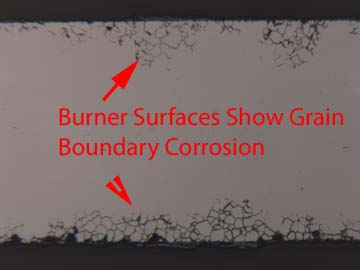
Corrosion engineer performed a metallurgy failure analysis to determine the cause of prematurely failing burners in a particular brand of gas grill. The burners in question would fail completely after two or three years of service. The failure analysis of the burner revealed that the grill manufacturer made the subject gas burners from an inferior grade of stainless steel. They used a relatively obscure alloy (J1). This alloy is a variation on 304 stainless steel. The 304 alloy contains 18% chromium (Cr), 8% nickel (Ni) and 2% maximum manganese (Mn), and it allows a maximum of 0.08% carbon (C). The J1 alloy allows the same amount of C but contains only 15% Cr; it also has 4% Ni and 8% Mn. Because the Cr is the active ingredient for the corrosion resistence of stainless steel, the J1 alloy will perform poorly in a corrosive environment. A by-product of burning propane in a gas grill is water. In addition, the burner is hot with other contaminants on it; a corrosion expert would state that this is a corrsive environment. Upper left is a photograph of a burner that failed prematurely. Upper right is an unetched metallugraphic sample of a piece of this burner. One can clearly see that the burner surface shows grain bounbary corrosion. It is believed that the low level of Cr and the presence of water and carbon makes the J1 alloy susceptable to stainless steel corrosion and unsuitable for gas grill burners. This product defect analysis indicates that this is a not a manufacturing defect but design defect.

Labels: , , , , , ,

Tuesday, October 20, 2009

Failure Analysis of Corroding Stainless Steel Probe


Failure analysis expert was asked to determine the cause of deterioration of the tip of a stainless steel (SS) probe used to measure the level of hot tomato juice in a vat. Chemical analysis identified the steel as 304 SS with 0.082% carbon. At best, the carbon limit is on the high end in an alloy that is prone to grain boundary corrosion. Metallographic analysis demonstrated to the corrosion expert that the grain boundaries of the steel were decorated with carbides. The upper left photograph shows the deterioration of the end of the tube. Upper right is a 400X metallograph of a polished and etched sample of the steel. The arrows indicate decorated grain boundaries. Because tomato products have a significant amount of malic acid, 316L stainless steel was reccomended for replacement.

Labels: , , ,